Make it in the Emirates 2026: Industrial AI Is Moving from Vision to Factory Floor
A founder's briefing from ADNEC Abu Dhabi
I visited Make it in the Emirates 2026 at ADNEC Abu Dhabi with the eyes of a founder, but also with the memory of many large-scale industrial events held at the same venue.
Compared with ADIPEC, which I know well from previous years, the event felt less crowded, less overwhelming, and easier to navigate. That was not a weakness. In many ways it made the experience more focused. There was more room to observe, reflect, and speak with people without the noise and intensity of the largest energy exhibitions.
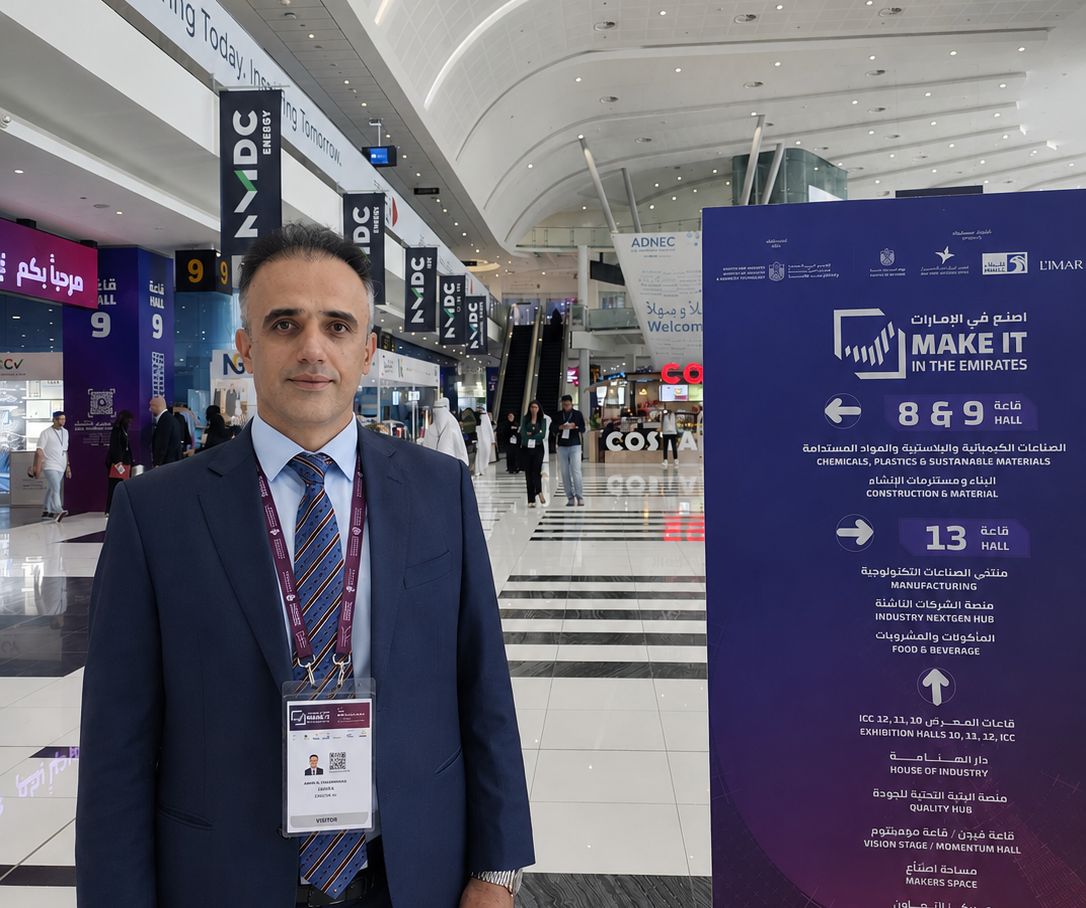
My main takeaway
The strongest message from the event was clear. The UAE is not only talking about industrial transformation. It is actively building the ecosystem around it.
The event showed how quickly the UAE is integrating AI, robotics, automation, advanced manufacturing, and industrial innovation into its national industrial agenda. That was visible in the technologies on display, the government presence, the industrial participation, and the attention given to startups.
For me, as the founder of Zanor AI, the most important signal was not the technology itself. It was the direction of travel.
AI is becoming part of the industrial operating model, not just a digital add-on.
AI and robotics are becoming industrial infrastructure
One of the more interesting aspects of the event was the presence of emerging technologies on the floor: edge-AI industrial systems, autonomous solutions, smart manufacturing platforms, humanoid robots, and industrial robotics.
These are not just “cool demos”. They point to a deeper shift.
In industrial environments, the real value of AI will come when it is embedded close to operations: near assets, production systems, factories, plants, logistics flows, and engineering decisions. Edge AI, robotics, digital twins, and autonomous systems are all part of this shift.
The official Startup Pitch Competition reflected the same direction. It welcomed startups across five priority sectors: electric mobility and batteries, autonomous systems and drones, industrial robotics, digital twins and smart manufacturing, and industrial cybersecurity.
This aligns strongly with Zanor AI’s view. The next phase of industrial AI will not be about isolated dashboards or one-off pilots. It will be about intelligent operating systems that connect data, domain knowledge, AI models, workflows, and human decision-making.
The big booths still matter, but they are not the whole story
As expected, the major industrial players and well-funded organisations had the largest presence. Polished booths, large structures, immersive screens, robotics showcases, and strong branding dominated parts of the exhibition floor.
This is normal in major industrial events. Large organisations can afford a strong physical presence, and their booths often become the main visual anchors of the event.
But from a startup founder’s point of view it raises a real question. How do smaller, specialist, innovation-led companies get noticed in an environment where attention is captured by scale, budget, and brand power?
This is where curated startup platforms become important.
A stronger space for startups
One of the positive signals from Make it in the Emirates 2026 was the dedicated attention given to startups through the Startup Hub and the Startup Pitch Competition.
MoIAT positioned these channels as ways for startups to showcase innovation, connect with industry partners, investors, and government stakeholders, and gain visibility within the wider industrial ecosystem.
This matters.
Industrial transformation cannot be delivered only by large companies. It also needs focused, specialised, agile innovators who can solve very specific problems in new ways. Startups bring speed, experimentation, and technical depth. Large industrial players bring assets, scale, procurement power, and operational complexity. The real opportunity is in connecting the two.
The event’s Industry NextGen Hub also included pitch competitions, investor matchmaking, business-to-business meetings with anchor buyers, and workshops on financing and supply chain integration. SMEs, startups, and entrepreneurs accounted for 61% of exhibitors at this year’s edition.
That is an important signal for the ecosystem.
What this means for Zanor AI
For Zanor AI, the event reinforced several beliefs.
First, industrial AI is becoming more practical. The conversation is moving from broad digital transformation language to specific capabilities: robotics, smart factories, digital twins, autonomous systems, industrial cybersecurity, edge intelligence, and AI-enabled operations.
Second, the UAE is building the right environment for industrial AI to scale. National strategy, industrial policy, investment appetite, and technology adoption are becoming more connected.
Third, the opportunity for specialist AI firms is real, but it requires sharp positioning. Startups cannot compete with the largest players on booth size or brand visibility. We need to compete on clarity, expertise, relevance, and the ability to solve high-value industrial problems.
For Zanor AI, that means staying focused on where we can create the most value: helping energy and industrial enterprises move from AI pilots to AI-native operations, with strong governance, domain understanding, and measurable business outcomes.
Founder reflection
My overall impression of Make it in the Emirates 2026 was positive.
It was not as crowded as ADIPEC, and it did not have the same intensity or global energy-sector scale. But it had a different value. It felt more focused on the UAE’s industrial future and the practical integration of advanced technology into manufacturing, supply chains, and industrial operations.
For a founder, that makes it highly relevant.
Events like this are not only about who has the biggest booth or the most impressive robot. They are about reading the direction of the market. And the direction is clear. Industrial AI is becoming central to how the UAE wants to build, manufacture, operate, and compete.
The challenge now is execution.
The next stage will require more than technology showcases. It will require adoption, operating model change, governance, talent development, integration with existing industrial systems, and clear business value.
That is where the real work begins.
Closing thought
Make it in the Emirates 2026 showed an industrial ecosystem that is becoming more ambitious, more technology-enabled, and more open to innovation.
For Zanor AI it was a strong reminder that the future of industrial AI will not be built only in labs or strategy documents. It will be built where operations happen: in factories, plants, fields, assets, supply chains, and decision rooms.
And that is exactly where AI needs to prove its value.