EAGE Annual 2026: Aberdeen, the North Sea, and the Rise of Hybrid Physics-AI
A founder's briefing from the 87th EAGE Annual Conference and Exhibition, Aberdeen
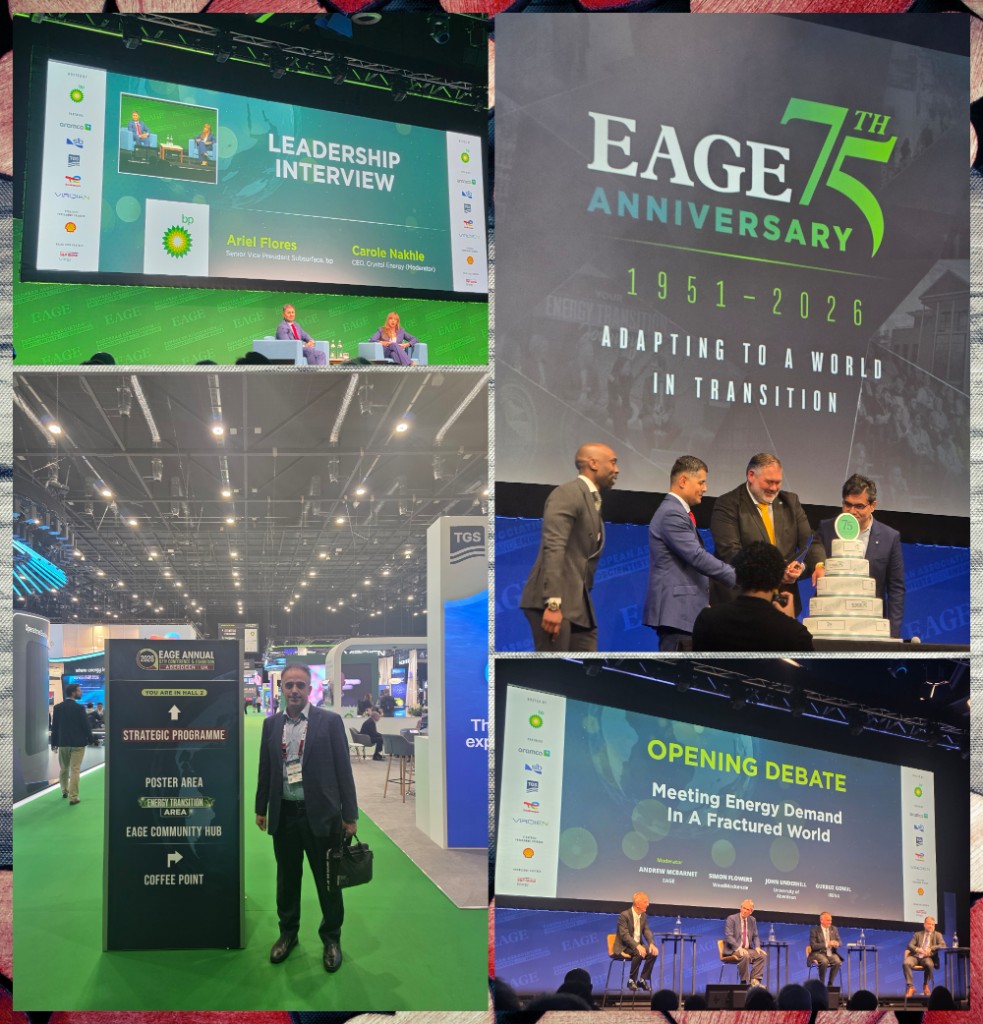
I attended the 87th EAGE Annual Conference and Exhibition in Aberdeen, held from 8 to 11 June 2026 at P&J Live. I went in three capacities: as a technical reviewer ahead of the event, as session chair on the days, and as an EAGE associate. The event ran in EAGE’s 75th anniversary year, under the anniversary slogan “Adapting to a world in transition”, and it was the European Association of Geoscientists and Engineers’ first return to the UK in a generation.
Aberdeen is also where my own career in subsurface started, with a six-month internship at bp in Aberdeen in 2002 and 2003. Returning to chair AI and machine learning sessions in the same city, twenty-three years later, was its own kind of marker.
Three things stood out clearly enough to be worth a briefing. The AI and machine learning papers in upstream geoscience have grown up. Aberdeen and the North Sea, with bp as host sponsor, spoke with a confidence I have not heard from the basin for some time. And the strategic, technical and exhibition strands of the event lined up around one message that the conference theme made explicit.
What I came away with
The headline impression is not one technology or one keynote. It is alignment. The conference theme, the host sponsor’s executive framing, the technical programme, and the exhibition floor were all pointing at the same place: mature basins, deep technical work, and AI that respects the physics of the asset and the experience of the people running it.
For a specialist AI firm focused on energy and industrial enterprises, that is the alignment we have been hoping for. The conversation has moved past whether AI belongs in subsurface and into the harder questions of how it should be built, embedded and operated alongside domain expertise.
The most important shift at EAGE 2026 was not that AI was on the programme. It was that the AI papers had finally stopped pretending they did not need the physics or the geologist.
1. The AI and machine learning papers have grown up
I chaired two sessions in the technical programme: one on AI and machine learning for fault interpretation, and one on production optimisation. Between reviewing for the programme and chairing on the day, I read and listened to a representative cross-section of the AI work submitted to the conference.
The first thing worth saying is that the average quality was high. There were fewer “we trained a model on a public dataset” papers and many more that started with a real subsurface problem, a real operator dataset, and a serious treatment of uncertainty.
The second, more important thing is the clear shift toward what the community is increasingly calling hybrid physics-and-AI, or physics-informed machine learning. The dominant pattern across the AI papers I saw was this:
- The model is anchored in domain knowledge: rock physics, structural geology, reservoir engineering, well behaviour.
- The machine learning component is doing the work it is good at: scaling pattern recognition across volumes of data that no human or classical workflow can read fast enough.
- The two are integrated, not stapled together. Physics constrains the model, the model amplifies the physics.
In fault interpretation, the better papers combined seismic attribute analysis and structural priors with deep learning architectures that learn fault probability volumes, rather than treating the seismic cube as a generic image. In production optimisation, the better papers built models that respected well constraints, decline behaviour and operational envelopes, and used optimisation methods that could be audited by a reservoir or production engineer.
The wider technical programme reflected the same shift. Lightning talks on ML and AI in the subsurface, sessions on ML and AI for seismic processing, work on AI-assisted seismic geomorphology and probabilistic mapping with vision foundation models. The two-day hackathon was framed around exactly this territory: making classic algorithms more performant with less energy footprint, using physics-ML for computationally prohibitive problems, and bringing methods from research labs onto production scale.
2. Aberdeen and the North Sea reasserted themselves
The choice of Aberdeen for the 2026 edition was not accidental, and the conversation reflected that. EAGE had not held its Annual in the UK for many years. Returning now, with bp as host sponsor, in EAGE’s own 75th anniversary year, and with the theme “Maximising recovery: Unlocking value through technology and partnerships”, was a deliberate statement about where the next phase of upstream value sits.
The Opening Debate set the tone. Held under the title “Meeting energy demand in a fractured world” and moderated by Andrew McBarnet (EAGE), it brought together Simon Flowers (Wood Mackenzie), John Underhill (University of Aberdeen), and Gurbuz Gonul (IRENA). The framing was deliberate. Energy demand is real and growing. The world that has to meet it is more fractured than it has been in a generation. That created the conditions for the technology-and-partnerships argument the conference would then make for three days.
The strategic conversation continued on the main stage in a Leadership Interview between Ariel Flores, SVP Subsurface at bp, and Carole Nakhle, CEO of Crystol Energy. Flores structured the bp argument around three focus areas that lined up with the conference theme almost word for word.
That framing landed well because the wider Aberdeen context backs it up. Aberdeen remains a global energy hub, with roughly 80 percent of the UK’s direct oil and gas employment based in the North East of Scotland and a workforce widely judged to have high skills transferability. Earlier in 2026 the UK government launched a new North Sea Future Board in Aberdeen to support the North Sea Future Plan, framed as a fair, managed transition rather than an abrupt one. And the basin has seen 14 Final Investment Decisions in UK offshore oil and gas this year, with Shell, bp and partners actively investing in mature central North Sea infrastructure.
The honest picture is that the North Sea remains a mature basin in long-term decline. The activity does not change that. What it does change is the operating reality of the next decade: a basin that needs the absolute best of subsurface engineering, applied AI and partnership-led delivery, because the easy barrels are gone and the technical bar to deliver the remaining ones is high.
That is precisely the conversation EAGE Annual 2026 hosted. Aberdeen did not pretend the structural decline was not real. It made the case that maximising recovery from this kind of basin is exactly where modern subsurface AI and engineering should be earning its keep.
3. The exhibition floor lined up with the technical message
The exhibition was substantial. More than 200 companies covered the full subsurface stack, from seismic acquisition and processing vendors to interpretation platforms, reservoir modelling tools, drilling and production technology, and a growing AI and digital cluster. A dedicated Energy Transition Area sat alongside the main subsurface aisles, which itself reflected the conference’s positioning that mature basin operations and the transition are the same conversation, just at different speeds.
What was striking was how much of the AI and digital presence on the floor mirrored the direction in the technical programme. Less generic AI pitching. More physics-aware platforms, more domain-specific accelerators for interpretation and modelling, more end-to-end workflows where the AI is one component rather than the whole product.
Vendors that have lived in this space for a while presented work that was visibly more mature than at recent events: real operator case studies, real deployment numbers, real uptake. The newer entrants leaned harder on integration with established geoscience tools, which itself tells you something about how the buyers in this audience evaluate AI products in 2026.
It was also a notable exhibition for partnership signalling. Sponsorships, co-presentations and joint stands between operators, service companies, software vendors and university groups were more visible than I remember from previous EAGE editions. The Flores third focus area, on partnerships, was visible on the aisles as well as the keynote stage.
What this means for Zanor AI
EAGE Annual 2026 reinforced the thesis Zanor AI was built on. AI in energy and industrial enterprises will deliver value when it is embedded in the technical work, owned by the domain experts who run the asset, and built with the operational discipline of a living system rather than a delivered project.
Three things follow for us, directly out of Aberdeen.
The hybrid physics-and-AI direction is now mainstream in the subsurface, and the operators are increasingly looking for partners who can do this work to the technical standard the geoscientists and reservoir engineers respect. That is exactly the standard Zanor AI is built to deliver against.
Mature basins, starting with the North Sea but not only the North Sea, are the natural home for this kind of work. The bar is high, the data is rich, the assets are complex, and the room for improvement is real. The bp framing of maximising recovery from mature basins is a near-perfect description of where industrial AI earns its keep.
Strategic partnerships are now a core part of how operators want to deliver this. Zanor AI has always been positioned as a practitioner-led partner that works alongside operators, service companies and academic groups, rather than as a vendor selling at them. EAGE 2026 made it clear that this is the model the next phase of subsurface AI will be built through.
Founder reflection
This was the first EAGE Annual I have attended where AI did not feel like a parallel track. It felt like part of the technical conversation, hosted by the geoscientists and engineers themselves, with bp’s executive line backing it on the main stage and the exhibition floor matching the direction.
Aberdeen is also personal for me. I spent six months as an intern with bp in Aberdeen in 2002 and 2003, working on surrogate model assisted history matching. The idea, even then, was to use data-driven models to stand in for expensive reservoir simulations and tighten the loop between data and decisions. Twenty-three years later, in the sessions I chaired at EAGE 2026 in the same city, I watched papers being presented on the same problem. The methods are better. The compute is unrecognisable. The fundamental challenge of getting a reservoir model to honour the data, and to do so quickly enough to support real engineering decisions, is still there.
That continuity is its own observation. Subsurface AI is patient work. The people who stay close to the physics and the asset for two decades are the ones who eventually move the methods.
Comparing this to the events I attended earlier in 2026, Make it in the Emirates in Abu Dhabi and the Oman Petroleum and Energy Show in Muscat, the underlying message is consistent. The Gulf is building industrial AI capability into national energy strategy. Oman is using its hydrocarbon strength to fund a credible transition. Aberdeen and the North Sea are making the case that mature basin operations are precisely the place where the best of subsurface AI and engineering will be tested.
Three different geographies. One direction of travel.
Closing thought
The 87th EAGE Annual was the right conference, in the right city, with the right host, at the right time. Aberdeen reminded the industry that the North Sea is not finished. bp’s Leadership Interview framed the strategic logic of mature-basin recovery, technology and partnerships in a way the wider programme then evidenced session by session. The AI and machine learning papers, particularly in the sessions I chaired, showed that the hybrid physics-and-AI direction is now the default, not the exception. And the Opening Debate set the geopolitical and demand-side backdrop honestly: a fractured world, with real energy demand, that has to be met by the people in that hall.
The work from here is the same work it has always been: getting these methods into operations, into the workflows and decisions of the engineers and geoscientists who actually run the assets, and doing so with the technical rigour and partnership discipline this audience expects.
That is exactly where Zanor AI works, and exactly the kind of conversation Aberdeen has just hosted.