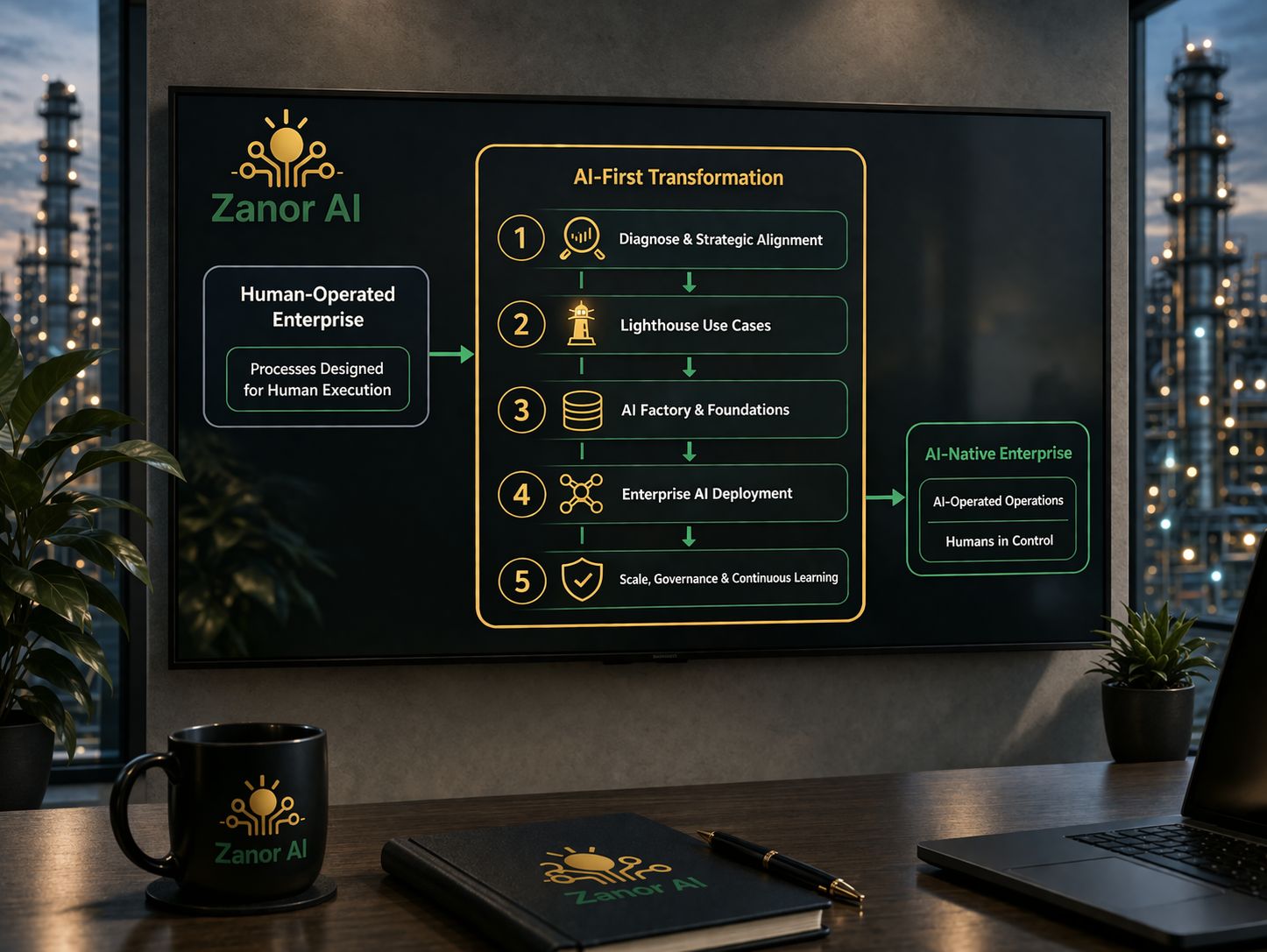
AI-First Transformation

Today's enterprises are human-operated.
AI-native enterprises are AI-operated with humans in control.

AI-First transformation redesigns operating models so operations, decisions, and optimisation are executed by AI systems with governance built in.

For energy and industrial organisations, this is how AI moves from pilots to daily operational value.

AI-native operating model Humans in control Built for energy & industrial operations
AI-First transformation visual

From Artificial Intelligence to Machine Learning and Generative AI

Artificial Intelligence (AI) refers to computer systems designed to perform tasks that typically require human intelligence. These include recognising patterns, making predictions, understanding language, and supporting decision making.

The field of AI has evolved over several decades through several major phases.

---
config:
  theme: base
  themeVariables:
    fontSize: '24px'
---
timeline
    title Evolution of AI
    1950s - 1960s : Early Artificial Intelligence
                  : The first wave of AI focused on rule-based systems, often called Symbolic AI or GOFAI, where human knowledge was encoded as explicit rules.
                  : These systems were useful for structured decision processes but struggled with complex real-world environments.
    1980s - 1990s : Machine Learning
                  : Machine Learning marked a major shift as systems learned patterns from data instead of hand-coded rules.
                  : This enabled predictive maintenance, recommendation systems, and industrial optimisation.
    2000s - 2010s : Deep Learning
                  : Advances in computing power and data availability enabled deep learning based on multi-layer neural networks.
                  : Deep learning made it possible to process complex data such as images, speech, and sensor streams at large scale.
    2010s - 2020s : Generative AI
                  : Generative AI systems can produce text, code, images, and design concepts.
                  : Large language models enable natural-language interaction, automate knowledge work, and support intelligent assistants.
          

These technologies are related but represent different levels within the broader AI landscape.

%%{init: {"theme":"base","flowchart":{"nodeSpacing":34,"rankSpacing":56,"diagramPadding":12}}}%%
flowchart TB
  subgraph AI["Artificial Intelligence"]
    direction TB
    AI_DESC["The broad field that includes many approaches
to building intelligent systems."] subgraph ML["Machine Learning"] direction TB ML_DESC["A subset of AI that allows systems to learn
patterns from data."] subgraph DL["Deep Learning"] direction TB DL_DESC["A subclass of machine learning based on
neural networks with multiple layers."] subgraph GEN["Generative AI"] direction TB GEN_DESC["A subclass of deep learning; these models generate new content
and interact with users through natural language."] end end end end AI_DESC --> ML ML_DESC --> DL DL_DESC --> GEN classDef desc fill:transparent,stroke:transparent,color:#3b4b44,font-size:12px,font-weight:500; classDef descLight fill:transparent,stroke:transparent,color:#FFFFFF,font-size:12px,font-weight:500; class AI_DESC,ML_DESC,DL_DESC desc; class GEN_DESC descLight; linkStyle 0 stroke:transparent,fill:none; linkStyle 1 stroke:transparent,fill:none; linkStyle 2 stroke:transparent,fill:none; style AI fill:#F7F6F2,stroke:#1C352D,stroke-width:2px style ML fill:#FFFFFF,stroke:#1C352D,stroke-width:2px style DL fill:#F7F6F2,stroke:#1C352D,stroke-width:2px style GEN fill:#CC8A24,stroke:#1C352D,stroke-width:2px,color:#FFFFFF

Generative AI matters because it makes intelligence accessible through natural language. It accelerates how organisations capture knowledge, automate workflows, and embed AI into everyday decision making. These are core enablers of AI-First transformation.

Understanding how these layers relate—from AI through machine learning and deep learning to generative AI—helps teams prioritise investments and build a coherent path to AI-First operations.

Why AI Transformations Fail

We have seen organisations invest heavily in AI platforms, analytics teams, and pilot projects yet struggle to achieve enterprise-wide impact. This is rarely a technology problem. In most cases the organisation itself has not been redesigned to absorb AI at scale.

Common Barriers to AI Transformation Success

Most enterprise operating models and processes were originally designed by humans to be executed by humans. As organisations introduce AI capabilities, these human-centric structures often prevent AI from influencing everyday decisions and operations.

AI initiatives disconnected from business value
Fragmented data and technology environments
Lack of scalable delivery capabilities
Insufficient governance and model risk management
Difficulty embedding AI insights into operational decisions

Without addressing these structural challenges, organisations accumulate experiments instead of achieving transformation.

From AI Tools to AI-Native Enterprises

Traditional Enterprise

Human-operated with AI assistance

  • AI is added as isolated tools and pilots.
  • Decisions are primarily human-driven.
  • Intelligence is fragmented across functions.
  • Limited feedback loops mean slower learning and adaptation.

AI-Native Enterprise

AI-operated with humans in control

  • AI is embedded into the operating model.
  • Decision workflows are AI-enabled by default.
  • Data, AI systems, and enterprise platforms operate as one intelligence layer.
  • Continuous feedback loops improve models and decisions over time.

The shift to AI-Native is not about deploying more models. It is about redesigning how the enterprise operates so intelligence is embedded across processes, decision systems, and technology platforms.

In this model, AI and human oversight work together: AI executes and optimises at scale, while people govern priorities, risk, and accountability.

This is how AI-First systems operate in practice:

---
config:
  look: handDrawn
  theme: base
  themeVariables:
    primaryColor: '#FFFFFF'
    primaryTextColor: '#212121'
    primaryBorderColor: '#1C352D'
    lineColor: '#1C352D'
    secondaryColor: '#F7F6F2'
    tertiaryColor: '#fff'
    clusterBkg: '#F7F6F2'
    clusterBorder: '#1C352D'
    titleColor: '#212121'
  flowchart:
    subGraphTitleMargin:
      top: 28
      bottom: 28
---
flowchart TB
classDef accent fill:#CC8A24,stroke:#1C352D,color:#FFFFFF;
class H accent;

subgraph S1[Operations Layer]
direction TB
A[Sensors & Industrial Systems]
B[Enterprise Systems & Applications]
end

subgraph S2[Data Foundation]
direction TB
C[Data Platform & Integration]
end

subgraph S3[Enterprise Intelligence Layer]
direction TB

D[AI Factory and Intelligence Development]
F[Decision Workflows & Automation]

G[Continuous Learning & Model Improvement]

end

subgraph S4[Business Outcomes]
H[Operational Value:
Production, Reliability, Cost, Safety] end S1 --> S2 S2 --> S3 S3 --> S4 D --> F --> G --> D style S3 stroke:#CC8A24,stroke-width:4px
How AI-First enterprises continuously generate business value by embedding intelligence across operations, data platforms, and decision systems.

Recognising these barriers—and redesigning the enterprise toward AI-Native operations—is the foundation for the AI-First transformation path that follows.

The AI-First Model

Building on the operating model, these six capabilities define how intelligence is embedded across the enterprise.

Core Capabilities of the AI-First Operating Model

Intelligence & Decisioning

Agentic AI Systems

Intelligent systems that reason, act, and orchestrate workflows, enabling decision execution and operational automation at scale.

AI-Native Decisioning

Decision workflows redesigned so AI, data, and feedback continuously shape how decisions are made across the enterprise.

Value-Linked Execution

Every AI capability is directly linked to measurable operational and financial outcomes, ensuring impact is realised and sustained.

Platform & Governance

Sovereign AI Platform

Enterprise-owned platforms that support secure development, deployment, and governance of AI systems. Data and models remain under organisational control for scalable, compliant operations.

Human-Governed AI

AI systems operate within defined boundaries with human oversight, ensuring accountability, risk control, and decision authority.

Continuous Learning Systems

Operational feedback from deployed systems is continuously captured and used to improve models, decision policies, and workflows over time.

Our Guiding Principles

These principles define how AI is designed, governed, and scaled to create sustained enterprise value. They underpin how the AI-First Model is designed and operated in practice.

Build for Value and Impact

Value First, Platform Second

Every platform capability must be justified by a clear business use case and measurable value.

AI as a Product

AI systems are managed as enterprise products with clear ownership, lifecycle management, and performance metrics.

Hybrid Intelligence by Design

Domain expertise and engineering models are combined with AI to create intelligence that is robust, explainable, and grounded in real-world systems.

Govern for Trust and Control

Sovereign and Secure AI

Data and AI models remain under organisational and jurisdictional control to ensure security, compliance, and IP protection.

Human-Governed Intelligence

AI augments human expertise within defined boundaries, ensuring accountability, oversight, and controlled autonomy.

Responsible AI by Design

Explainability, bias monitoring, and model risk tiering are embedded from the beginning.

AI-First Governance

These governance mechanisms put these guiding principles into practice and ensure AI systems remain controlled, trusted, and compliant at scale.

Governance and Risk Control

Responsible AI and Governance Frameworks

Policies and practices that ensure transparency, fairness, and accountability across the AI lifecycle.

Enabling trusted AI adoption while reducing ethical, regulatory, and reputational risk at scale.

Model Risk Management and Tiering

Structured assessment and classification of models based on business impact and risk exposure.

Prioritising oversight and controls to ensure high-impact systems are governed appropriately and safely.

Compliance and Sovereignty

Regulatory Compliance by Design

AI systems designed to meet regulatory and organisational compliance requirements.

Reducing compliance risk and enabling faster deployment within regulated and high-assurance environments.

Sovereign Data and AI Systems

Secure architectures that ensure data and AI systems remain under organisational and jurisdictional control.

Supporting data sovereignty, security, and regulatory alignment in national and enterprise contexts.

In the AI-First Operating Model, these capabilities, guiding principles, and governance mechanisms, together guide how AI is designed, governed, and scaled for sustained enterprise value.

Transformation Phases

AI-First transformation follows a structured journey in which organisations redesign operating models built for human execution so that AI systems progressively participate in and execute operational decisions, while humans retain governance and strategic control.

Diagnose and Align

Assess organisational readiness, data foundations, and value opportunities to define the AI-First transformation roadmap.

This phase establishes leadership alignment around the shift from human-operated processes toward AI-enabled decision systems and identifies priority value opportunities.

Lighthouse Use Cases and Learning

Targeted lighthouse use cases demonstrate measurable business value and validate how AI fits into operational decision workflows, with programme leadership and execution aligned to internal teams and partners.

These lighthouse initiatives generate early impact while enabling organisations to learn how to integrate AI into processes, governance, and human-AI interaction.

AI Factory and Foundations

Organisations establish the enterprise AI factory: data platforms, AI development environments, pipelines, and cross-functional teams—often built with internal capacity and partner ecosystems.

This phase creates the scalable technical and organisational foundation to integrate AI with enterprise operations, with clear ownership, governance, and a path from design into production.

Enterprise AI Deployment

The organisation embeds AI capabilities across operational processes, decision workflows, and enterprise platforms.

Rather than isolated models, organisations deploy interconnected AI systems that continuously interact with operational data and business processes.

Scale, Govern and Learn

Expand AI adoption across the organisation while establishing strong governance, model risk management, and value monitoring.

Operational feedback loops enable AI systems to continuously learn from data and decision outcomes, allowing the organisation to evolve toward AI-Native enterprises.

This journey translates the AI-First Model and guiding principles into a practical execution path.

Business Outcomes

AI-First transformation translates directly into measurable operational and financial outcomes. As intelligence becomes embedded across the enterprise, systems continuously learn from data and decisions, improving performance over time.

It is a transformation from isolated AI use cases to enterprise-wide performance gains.

Operational Performance

Production & Operational Performance

AI-driven optimisation improves production planning and operational efficiency.

Typical AI programmes

3-10% production uplift

AI-First transformation

5-15% sustained improvement

through integrated optimisation across operations.

Asset Reliability & Predictive Maintenance

AI monitoring detects early equipment degradation and operational anomalies.

Typical AI programmes

20-40% reduction in unplanned downtime

AI-First transformation

30-60% reduction

through fleet-wide predictive intelligence.

Cost & Value Chain Optimisation

Integrated AI platforms identify inefficiencies across operations and supply chains.

Typical AI programmes

5-10% cost reduction within functions

AI-First transformation

10-20% enterprise-level cost optimisation

Enterprise Effectiveness

Safety

AI-driven monitoring and decision support improve safety performance and reduce operational risk.

Typical AI programmes

Incremental improvements in monitoring and reporting

AI-First transformation

System-wide risk reduction

through integrated operational intelligence.

Executive Decision Intelligence

AI copilots and decision systems transform operational data into real-time leadership insights, enabling faster and more consistent decision-making across the enterprise.

Typical AI programmes

Improved reporting and analytics

AI-First transformation

30-50% faster decision cycles

and enterprise-wide situational awareness.

Planning & Scheduling Optimisation

AI-driven planning and scheduling optimise production, maintenance, and logistics decisions by continuously adapting plans based on real-time data and constraints.

Typical AI programmes

Static or periodically updated plans with limited optimisation

AI-First transformation

10-25% improvement in planning efficiency

and reduced schedule disruptions.

The result is an organisation capable of continuously generating and applying intelligence across its entire value chain.

Explore the AI-First Model for Your Organisation

If the AI-First approach resonates with your goals, we would welcome a conversation about how it could shape your transformation roadmap.

Schedule a Strategy Discussion